As school systems prepare to reopen, here’s how to create a safe and effective learning environment for everyone.
Back to school: A framework for remote and hybrid learning amid COVID-19
Tuesday, September 1, 2020

To take off, flying vehicles first need places to land
The buzz about vehicles flying above hides the infrastructure challenge below.
To take off, flying vehicles first need places to land
To take off, flying vehicles first need places to land
Boosting Business Value by Reducing COVID-19 Transmission Risk
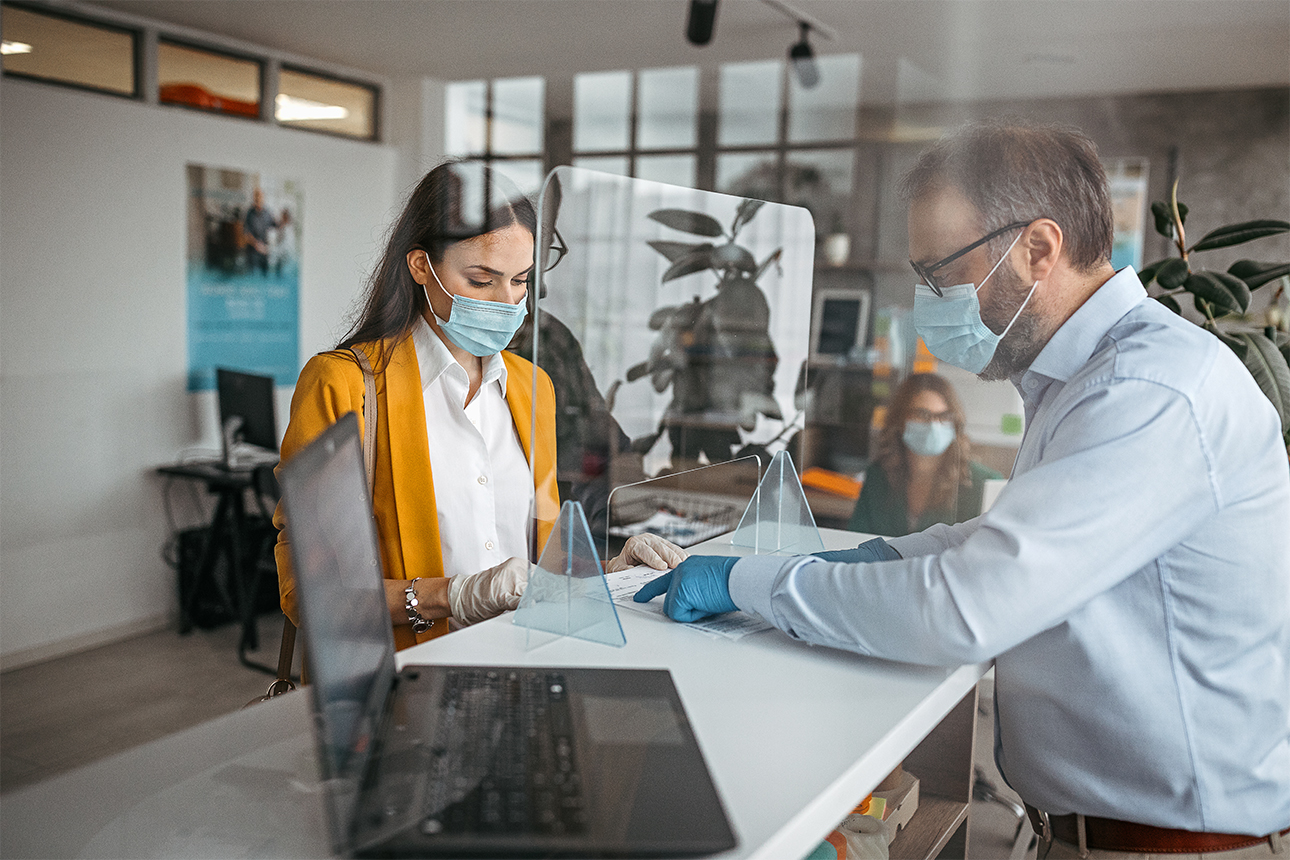
Starting business meetings with a handshake, laughing with friends in a bustling restaurant, or squeezing onto a crowded commuter train: Before the coronavirus pandemic, these were the completely unremarkable events of everyday life. But in the absence of an effective vaccine or test-and-trace system, these activities now carry deadly risks. Naturally, individuals, businesses, and governments have taken dramatic actions to reduce the number of social interactions to prevent the spread of COVID-19 and a deepening of the pandemic.
Reducing social contact to slow the spread of the virus has had a major impact on the U.S. economy, but not all businesses have been equally affected. Some companies provide better trade-offs. Those offering more social and economic importance per social interaction that poses potential risks face less government regulation and a smaller reduction in visits from fearful customers. Governments, businesses, and individuals should seek to maximize the bang for their buck from social interactions. And organizations that can boost their value-risk trade-offs are even in a position to benefit from the crisis.
In our recent research paper, “Rationing Social Contact During the COVID-19 Pandemic,” published in the Proceedings of the National Academy of Sciences, we measured the value-risk proposition offered by 26 different location types throughout the U.S.1 Locations we considered are generally for-profit (such as different types of retailers, entertainment venues, and service providers), but we also looked into the trade-offs offered by some nonprofit organizations.
Regarding benefits, we measured the economic importance of a location in terms of its receipts, employee counts, and payroll. We also included consumer importance as measured through a nationally representative survey. Such surveys have been used in the past to measure the value of free digital goods.2 In this survey, respondents could choose between a pair of locations and decide which one they would prefer to remain open.
To measure the cumulative risk of a location type, we looked at a combination of nine factors drawn from smart-device GPS mobility patterns. A location is considered more dangerous if it is visited frequently and by large numbers of people, and if those visits result in crowding at certain times of day. We considered these factors for the general population but also focused on individuals age 65 and over, a population at higher risk of developing a serious case of COVID-19. Another factor we incorporated was the distance people traveled to given locations from their homes. This last component captures the amount of social mixing at a specific location by people originating from different locations, while the other measures capture the intensity and amount of social interaction. Each of these social mixing measurements was evaluated for each location type.
The figure “Cumulative Danger and Importance of 26 U.S. Location Types” summarizes our findings. The locations that offer the best aggregate risk-reward ratio include banks, grocery stores, department stores, and general goods stores. These locations all offer very high social importance, with banks and grocery stores rating higher because they offer critical services to customers and serve as employers.
The locations that we find offer the worst trade-offs include gyms, liquor stores, sporting goods stores, and cafes. These are generally small, highly trafficked, and highly crowded locations. They are also of lower social importance. While we visit these locations often, they contribute relatively little to GDP, employment, and welfare in terms of the daily necessities they offer consumers and the number of employees served.
These risk-reward trade-offs have profound implications for businesses. From February to March 2020 (the latter being the first month of wide-scale actions to enforce social distancing in the U.S.), visits to all locations in the 26 categories we evaluated declined 24.9%. According to our analysis, this decline was concentrated in locations offering worse risk-reward trade-offs. While banks experienced only a 2% decline in visits during this period, gyms experienced a 33% decline.
Even outliers are usually driven by consumers’ desire for safety. Hardware stores, despite offering a mediocre risk-reward ratio, actually saw a 19% increase in visits from February to March. We speculate that this was due to consumers stocking up on personal protective equipment, such as masks, and high-demand supplies. Visits to grocery stores also increased by 15%, likely due to consumers seeking to substitute one grocery store visit for multiple risky restaurant visits.
How to Boost Your Value Proposition
Given the data findings and the continued risks to public health, it’s clear that boosting organizations’ risk-to-value proposition is both a financial and moral imperative. Companies that establish reputations for having safer locations will be rewarded by risk-averse clients. Leaders should keep in mind that the effectiveness of potential interventions will vary depending on the business’s type of location.
Implementing Sanitation and Distancing Best Practices
One critical first step every company must take, regardless of industry or location, is implementing basic health and safety best practices by disinfecting surfaces, putting protective barriers in place for staff members and clients, and requiring mask use. Mask wearing is especially important for industries that involve close-proximity personal services, such as hair salons. By looking at the share of workers by occupation in an industry and combining this data with O*Net occupational characteristic scores, we can estimate how much an industry relies on physical proximity. Industries with low scores can more easily allow employees to practice social distancing or work from home, whereas masks will be essential for industries with high scores. In our analysis, we found that dental offices and salons and barbershops are the only two location types with a high share of workers requiring extended close proximity. Amusement parks, gyms, and restaurants of all types also have high shares of workers requiring some degree of proximity to do their jobs.
Scheduling Visits
Companies and business owners can also take steps to lower risk in their physical locations by modifying their business hours and admitting customers on a staggered schedule that creates lower density. Keep in mind that strategies aimed at lowering risk can have their own drawbacks. For instance, having customers wait outside a store while it is at its (reduced) maximum capacity means a higher chance of frustrated customers and still allows the opportunity for customers to infect one another. Much better alternatives include special hours for vulnerable populations, time-restricted coupons, surge pricing, and increased enforcement of scheduled rather than walk-in visits.3 Time-restricted coupons and discounts also have the benefit of doing less to dissuade spontaneous and impulsive visits compared with strict scheduling.
Offering Premium Lower-Density Services
During the pandemic, companies that have provided tiered services may need to pause or disband options previously available to customers that are now less safe. A tutor or personal trainer who has offered both individual and group training might decide to focus on premium one-on-one services, for example. A larger-scale example comes from Uber and Lyft canceling their discount ride-sharing options that pool multiple riders in one vehicle. Businesses continuing to offer services that push large numbers of clients together are likely to face both lower demand and more resistance from their employees and governments.
The figure “Potential for Reducing Crowding by Scheduling Attendance” looks at how different business types can benefit by better using spare capacity. On the x-axis is the importance-risk trade-off favorability of a location. On the far left are gyms, which offer the worst trade-off; on the far right are banks, which offer the best trade-off. The y-axis plots location types by the average variance of their crowdedness. A location with high variance in crowding is very crowded at some points but nearly empty at others, such as the typical cafe or liquor store. Locations in this category have more to gain from new strategies for customer visits.
The good news is that locations that offer the worst trade-offs due to COVID-19 have the best opportunities to improve their safety through customer timing and scheduling changes — such as clothing stores, dentists, liquor and tobacco stores, and restaurants of all types. This is demonstrated by the strong negative trend line. For dentists and restaurants in particular, where visits are commonly scheduled in advance, reductions in transmission risk might be easily achieved with little disruption to processes or increases in costs.
Know Your Brand
Within a location type, there can be large variation in the potential gains from rescheduling visitors. In the figure below, the top and bottom panels show the cumulative danger due to proximity and the potential for danger reduction through scheduling visits for the 30 top restaurants brands in the U.S. As before, the marker sizes indicate the total monthly visitors in February 2020. Unsurprisingly, for each of these location types, the number of visits to a chain (marker size) is positively related to the cumulative danger of the chain (position on the x-axis).
What else does this figure show us? Consider, for example, a pair of restaurant chains: The Cheesecake Factory and Ruby Tuesday. Both chains have approximately the same number of normal visits monthly: about 1.7 million. However, they vary dramatically in terms of their current safety and the safety they might gain through rescheduling. The Cheesecake Factory’s guests are concentrated in short periods, with the highest visit-weighted average crowding variance at open locations compared with any restaurant brand. This leads it to have a much higher danger index than Ruby Tuesday, despite having the same number of visits. In order to better deliver value to customers during the COVID-19 crisis, The Cheesecake Factory should take steps to reduce the crowding of its restaurants during peak hours.
Generally, restaurant chains strongly associated with a single meal or event type tend to have higher variance in crowdedness over time. For example, IHOP (breakfast), Texas Roadhouse (dinner), and Buffalo Wild Wings (sporting events) all have above-average variance in crowdedness. These chains have the most to gain by redistributing their visitors throughout the day. However, due to the strong association of their brands with these events, they may face additional challenges in doing so. The takeaway from this is that businesses face an important trade-off in creating an identity that is tightly associated with a particular event or time of day. This association may prevent them from fully utilizing capacity in off-peak hours.
Within grocery and department stores, there is also significant variation in the amount that stores can gain through redistributing visits across time. Within grocery stores, ShopRite and Kroger have much higher variance in crowding than Winn-Dixie, Whole Foods Market, Aldi, and Publix. Within department stores, Target and Sears have higher crowding variance than J.C. Penney and Safeway. Kohl’s is doing a particularly good job at keeping its stores evenly attended and therefore has a very small cumulative danger score for its number of visitors.
How can businesses best protect their customers from the coronavirus while still delivering or even increasing the value they offer? How businesses answer that question is a critical success factor moving forward. Companies need to meet government regulations but also attract and win back customers and clients based on their proactive risk-prevention measures. Not every business will find this easy, but boosting quality never is. The only alternative is a dismal one — businesses undertaking coronavirus safety “theater,” and cynical clients and governments looking the other way, while hundreds of thousands more die.
But there is a silver lining to this challenge. It is exactly the type of problem that market forces are good at solving. In the past, competitive pressures have forced companies to economize on resources. Today, they must economize on social proximity as well. As long as clients, workers, and governments demand this of their economies, the invisible hand of competition will deliver it.

Boosting Business Value by Reducing COVID-19 Transmission Risk
How governments can deliver on the promise of digital ID
Governments globally are working to roll out digital identity schemes, but few have achieved broad adoption and utilization. To succeed, governments can create a virtuous circle of supply and demand.
How governments can deliver on the promise of digital ID
How governments can deliver on the promise of digital ID
Monday, August 31, 2020
The Pandemic’s Lessons for Managing Uncertainty

As we move through the emerging reality of the coronavirus, what have we learned that will help organizations navigate the coming months?
I’ve been following the experiences of four companies — Tata Consultancy Services (TCS), Vodafone, Arup, and Artemis Connection — over the past several months. Each is facing big unknowns. None of the leaders of these companies believes they have all the answers yet; all describe their organizations as being in motion.
While each company’s experience is unique, common themes are emerging that are proving crucial to their journeys: the importance of project management; the need to embrace trial and error; the floating of big, long-term questions; and an excitement to build on the upsides of this moment. Here, I illustrate the four themes through the lens of these companies.
Get Project Management Basics in Place
In each of the companies I’ve been talking with, embedded and non-negotiable project management practices have been key to navigating the initial pivot to virtual workplaces. These practices were subsequently embellished and tweaked for an emerging COVID-19 reality, but the basic architecture of commitments was crucial.
The technology company Tata Consultancy Services (TCS), headquartered in Mumbai, has spent almost a decade building and refining a series of virtual platforms that enable employees to work collaboratively outside of the traditional office. For its staff, transitioning to a more fully virtual work life has meant expanding its established best practices.
Ramkumar Chandrasekaran, TCS’s human resources director for the U.K. and Ireland, told me how they utilize at least 10 different project management action practices. For instance, live dashboards are shared across locations that track the progress of assigned work, share the outcomes of key deliverables, establish whether projects are on schedule, and create a platform for teams to identify and take action on short-term fixes. Teams also often start each day with short (no more than 15 minutes) meetings to discuss what worked and didn’t the day before, and to identify priorities for the coming day.
Dashboards and daily check-in meetings aren’t groundbreaking tools, and indeed they could be found in any textbook on managing virtual projects. The real lesson here is the crucial importance of companywide embedding of and commitment to using these techniques.
Embrace Trial and Error to Manage Challenges
It is becoming increasingly clear that there is no obvious end state for what it means to operate in the age of COVID-19. Instead, there are big, new unknowns to be acknowledged and tackled. As a result, across all four companies, there has been an emphasis on trial and error, listening deeply to the market and to employees, and making constant adjustments.
Back in March, Vodafone, a U.K.-based telecom company, pivoted in less than a week from a primarily office-based employee group to a home-based workforce. Anne Sheenan, director of Vodafone Business U.K., said that one of the biggest early pain points were social connections, which began to fray during the lockdown. Employees missed the sociability and serendipitous interactions of the office environment.
So Sheenan began experimenting with an informal program called “Sandwich with Anne.” Twice a week, she invites for lunch 12 employees from different areas of the company — for instance, marketing and digital. “We send each invite a sandwich lunch at their home address, then around 1 p.m., we sit down for a virtual lunch and talk for about an hour,” she told me. Her goal is to break barriers by being open and removing any intimidation about meeting with her.
The meetings help people to establish new connections beyond their immediate circle. Other leaders within the organization have started to do the same, and the plan is to keep the lunches going at least through the summer.
It could well be that initiatives like this one have relatively short shelf lives. But that’s not the point. The crucial aspect is to be on the lookout for what’s necessary and to continually fine-tune your responses.
Explore the Hard Questions That Affect Your Future
All the leaders I’ve been speaking with are in situations of extraordinary complexity and ambiguity. They cannot yet know what all the right answers will be for the future. But they can begin to identify the right questions. These are questions that probably can’t be answered yet, but for which an answer will emerge.
For Arup, a core and currently unanswerable question is, “What is space for?” Based in London, Arup is a global engineering design company that traditionally has created collaborative offices and some of the most iconic public spaces across the world, including Apple Park in California, the Singapore Sports Hub in Kallang, and the Sydney Opera House. Not surprisingly, the pandemic is making Arup face profound questions about its purpose and practices.
Like most companies, Arup is grappling with the current paradox of remote working — that few people are looking forward to getting back to working continuously in an office, but few want to work continuously at home.
In a webinar I hosted in June with Jenni Emery, Arup’s global people and culture leader, we talked about the need for new strategies for building collaboration and innovation now that face-to-face meetings and serendipitous encounters are no longer a given. Early in March, Arup explored this question by launching a worldwide conversation about how the company could prepare for the future. The #allears initiative was an online, facilitated conversation than brought together more than 4,000 “Arupians” over a three-day period. It gave people the chance to begin to float innovative ideas while keeping in mind the importance of being intentional and considered. At the same time, the company began running virtual consultations with their stakeholders around reimagining cities and public spaces.
For Emery, one of the key issues in exploring hard questions like “what is an office for?” is acknowledging and balancing the significant tension between the near term and the long term. Right now, any ideas about what an office is for has to be seen through the lens of current health and safety restrictions. Yet in the longer term, answers will inevitably focus on building new, creative ways to reimagine office space.
The insight for Arup, and the lesson for other leaders, is acknowledging that while some answers will be interim, it is those who build for the longer term that will offer a significant opportunity for reinvention.
Build On the Upsides
Less than a year into the pandemic, most companies are still in a state that experts in change management sometimes call “unfreeze”: Practices that had previously created solid business processes and structural architecture have thawed. The next phase of change — the “refreeze” step — will be when new crystals metaphorically begin to form around the new systems and routines.
It’s clear that many employees and companies don’t want to go back to the old order. But for a new order and ways of working to emerge, the upside of these new ways of working have to be understood and embraced. Simply put: If people don’t see the upside of the future state, they will hanker after the past.
Artemis Connection, a small strategy consultancy in the Seattle area, is an interesting case study because the business was “born virtual” in 2015, and some of its employees have never met other colleagues face-to-face. Founder and CEO Christy Johnson told me that she learned early on to make the upsides of virtual working crystal clear. Many Artemis employees joined from bigger companies because, while they loved consulting work, they hated the inflexibility of hours. So in building a virtual organization, one of the foundations for Johnson was emphasizing the upside of flexibility: “We tell people, ‘We believe in work-life integration, and you will have a chance to have more control over the pace of work and how you sequence it.’” Her own personal style, for instance, is to do her thinking work in the early morning, so she structures her schedule to keep that part of the day open.
Across the organization, this flexibility is made possible by planning work in cycles of 15- to 20-hour blocks of time. This forms the framework of both client projects and individual time commitments. “For example, if we are scoping a project like writing a weekly intelligence brief, we might calculate it’s roughly 60 hours of work a week,” said Johnson. “That’s four blocks, so we either need two people who can do two blocks, or four who will do one.”
The upside of time flexibility has made a real difference to the lives of employees, many of whom have flourished by developing significant involvement with their community and in social issues. As critical, Johnson says, is that they’ve also been able to transition to the challenges presented by COVID-19 stay-at-home orders (and work-from-home choices) more easily than companies where flexibility was not already baked into the culture.

The Pandemic’s Lessons for Managing Uncertainty
Saturday, August 29, 2020
COVID-19 and climate change expose dangers of unstable supply chains
With the world undergoing its second “once in a generation” disruption in 12 years, a reappraisal of supply chains is in order.
COVID-19 and climate change expose dangers of unstable supply chains
COVID-19 and climate change expose dangers of unstable supply chains
Friday, August 28, 2020
Thriving in Latin America’s next normal: Commercial excellence in CPG
Our latest survey shows that the region’s leading consumer-packaged-goods companies are agile, collaborative, data driven, and digital in their commercial approach.
Thriving in Latin America’s next normal: Commercial excellence in CPG
Thriving in Latin America’s next normal: Commercial excellence in CPG
Subscribe to:
Posts (Atom)